November 8, 2011
into the stacks: the secret garden
posted by soe 2:04 am
I’m starting to feel like work is finally starting to come back to a manageable piece of my life, rather than the all-consuming, life-eating monster it was during October.
So let’s try to do some literary housecleaning posts this week. Still to come are reviews of Still to come are reviews of The Woman in White; Diamond Ruby; Miss Peregrine’s Home for Peculiar Children; 13 Little Blue Envelopes; Ninth Ward; Will Grayson, Will Grayson; The Physics of Imaginary Objects; and Cats Are Weird and More Observations.
But rather than review those, I’ll give you a quick review of a beloved classic, which is the most recent thing I’ve finished:
The Secret Garden by Frances Hodgson Burnett
(more…)
October 5, 2011
national bookfest, belated recap
posted by soe 12:11 am
This past weekend was busy, but not as busy as the previous weekend, where I failed to figure out how to clone myself in order to be at every author reading I wanted to catch during the 2011 National Book Festival.
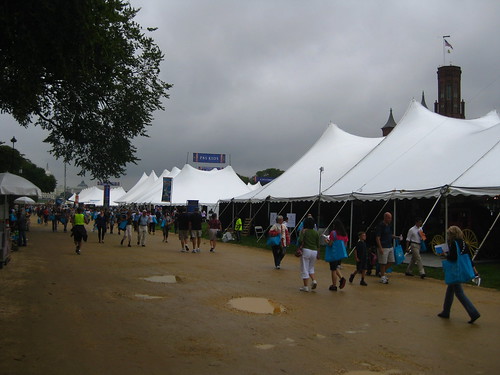 (more…)
September 26, 2011
into the stacks: a taste for death
posted by soe 2:31 am
I’m way behind on my book reviews, but figured I’d start off with the one I just finished. Still to come are reviews of The Woman in White, Diamond Ruby, Miss Peregrine’s Home for Peculiar Children, 13 Little Blue Envelopes, and Ninth Ward.
A Taste for Death, by P.D. James
From the jacket: “Their throats slit, the two men have turned the old vestry of St. Matthew’s Church red with blood. In death united, in life no men could have been more disparate: one a baronet and minister of the Crown; the other an alcoholic derelict. Commander Adam Dalgliesh believes that a single thread connects the two lives, one that will lead him to the killer. Instead, he soon finds himself following a tangled skein of lofty emotions and base ambitions into Britain’s enigmatic upper class — and into a labyrinth of ever-widening scandal and murder without end…”
My take: Commander Adam Dalgliesh has been named to head up a special division at Scotland Yard — one that investigates serious crimes that needed to be handled delicately, such as those of a political nature. Chief Inspector John Massingham and Inspector Kate Miskin round out the higher echelon of the team. Called to a Paddington church to investigate the deaths of a homeless man and a baronet, the team finds their first case seems to offer the initial and obvious answer that the rich man murdered the poor one and then killed himself with his own straight razor. However, the case seems to be a little too pat for Dalgliesh, who had a passing acquaintance with Sir Paul Berowne. With underlings in tow, they investigate everyone remotely involved with the man, from his beautiful wife (who is carrying on with an obstetrician) to his estranged daughter (who is dating a known Marxist) to his haughty mother to his local party officials. Following up on two other deaths loosely tied to Berowne convince Dalgliesh that he is correct that a murderer is on the loose. But with everyone trying to hide something, will he be able to find the guilty party in time?
I picked this up at a library book sale, part of their “fill a bag” day. If I’d had to pay for it, I might not have picked it up. And, frankly, that might not have been a bad thing.
I like cozies. I like police procedurals that are light on grisly crime and heavy on keeping peace among quirky characters. I prefer mysteries that are light and read quickly and that offer me a happy ending. I am happy to work to figure out the whodunnit, and even happier if the author has outwitted me at the reveal (provided that I can see where I should have sussed out the criminal). And I want my books to have plot lines that are wrapped up at the end of the novel and not left dangling, leaving you to wonder if the author bothered to re-read her text before sending it in and whether the decline in editing you’ve noticed recently could possibly date back as far as 1986 to when this novel was published.
It took me a month to wallow through the description and elevated language of this novel, and I sympathized greatly with the detectives, who were busy sorting through a lot of useless details in search of the actual narrative of a man’s final weeks. Some characters (particularly a romance novelist constituent of Berowne’s) are well developed, but far too many others (such as Lady Berowne) are only lightly adapted sketches of common archetypes.
I don’t know whether this work is indicative of James’ abilities in general or her Dalgliesh series in specific or an anomaly in an otherwise stellar career. However, it definitely has left me disinterested in finding out more, and that would seem to be a flaw in any mystery series.
Pages: 497
September 18, 2011
into the stacks: the map of true places
posted by soe 2:40 am
Another book down in an effort to catch up reviews:
The Map of True Places by Brunonia Barry
From the jacket: “Zee Finch has come a long way from a motherless childhood spent stealing boats…. She’s now a respected psychotherapist … about to marry one of Boston’s most eligible bachelors. But the suicide of Zee’s patient Lilly Braedon throws Zee into emotional chaos and takes her back to places she thought she’d left behind.
What starts as a brief visit home to Salem after Lilly’s funeral becomes the beginning of a larger journey for Zee. Her father, Finch, long ago diagnosed with Parkinson’s disease, has been hiding how sick he really is. His longtime companion, Melville, has moved out, and it now falls to Zee to help her father through this difficult time.”
My take: When Bridget finished reading this book, she was kind enough to send it to me after I expressed interest in it, having enjoyed Barry’s first novel, The Lace Reader.
The two books share a number of similar traits — the setting of Salem, Mass; the use of flashbacks as a narrative device; a female protagonist forced to return home due to a family crisis; a sympathetic male lead; an abusive character; and an interest in mental illness.
The Map of True Places revisits Salem in a time period not long after the end of the previous work and even resurrects some of the characters from it, but it is not a sequel and can be read comfortably without having encountered the other novel.
We first meet Zee, a Boston psychiatrist, immediately after the suicide of one of her patients. Because this patient had exhibited symptoms that reminded Zee of her mother — who had killed herself when Zee was a girl — Lilly’s suicide hits Zee particularly hard. Already under stress from wedding planning gone awry, Zee follows up the emotional funeral by finding her Parkinson-ridden father having a delusional episode and her step-father (his caregiver) no longer living at home.
So Zee takes a leave of absence from work to move home to Salem and take care of her dad, whose illness has taken a turn toward Alzheimer’s. She tries to figure out a way to reunite her father and step-father, who have argued over something they both refuse to divulge. She meets Hawk, a sailor/navigator who moonlights as a carpenter, who builds Finch some railings for around the house. And she tries to finally come to terms with her mother’s mental illness and suicide — and the historic love story she was obsessing over at the time of her death.
If you have read The Lace Reader, then you will be unsurprised by the direction this story takes. It feels heavy handed, relying on coincidence rather than magical realism to get you over some gaps in reality. Because of that, it may be that even without having read Barry’s previous work, you’ll suss out where this book is going before it gets there.
Nonetheless, it is a gripping and tense page-turner, and while you may sometimes need to put the book down in order to leave Zee in a safe place while you tend to more mundane aspects of your life, you will pick it up again as soon as you can to serve as a witness to her journey into the darkness of the unknown and back again.
Pages: 403
September 15, 2011
into the stacks: boy: tales of childhood
posted by soe 2:45 am
I’m out of order and behind in telling you what I’ve been reading. For the record, we’re temporarily skipping reviews of The Woman in White and The Map of True Places, which I’ll get back to soon.
Boy: Tales of Childhood, by Roald Dahl
From the jacket: Where did Roald Dahl get all of his wonderful ideas for stories? From his own life, of course! As full of excitement and the unexpected as his world-famous, best-selling books, Roald Dahl’s tales of his own childhood are completely fascinating and fiendishly funny. Did you know that Roald Dahl nearly lost his nose in a car accident? Or that he was once a chocolate candy tester for Cadbury’s? Have you heard about his involvement in the Great Mouse Plot of 1924? If not, you don’t yet know all there is to know about Roald Dahl. Sure to captivate and delight you, the boyhood antics of this master storyteller are not to be missed!”
My take: For many years, I didn’t think I liked Roald Dahl books. Sure, occasionally a story proved to be an exception (The BFG, for instance), but it was only last summer when I suddenly got Dahl. To celebrate that fact (and because she is a wise woman), Karen gave me this short collection of autobiographical vignettes Dahl wrote toward the end of his career.
Dahl shares stories of his growing up years — his young childhood in Wales amidst his large family (headed up by his loving and delightful widowed mother). He offers up fond memories of summer vacations to his mother’s homeland, Norway. He records a few good anecdotes of his schooldays, but also some horror stories that might inspire a few children into wanting to be homeschooled to avoid such misery. And his encounters with doctors of the 1930s are best told after dark around a campfire.
Dahl’s writes as if he were a guest in your home or a favorite great-uncle regaling you with stories about a childhood long ago and far away. His humor and razor-sharp characterization here rival those in any of his novels, with his villains painted in particularly lurid hues.
I recommend this to anyone whose kids have liked Lemony Snicket’s snarky tones, the madcap adventures of Cheaper by the Dozen (either the book or the movies), or any of Dahl’s fictional work; to those who are convinced that they missed out by not attending an English boarding school; and to humor-lovers everywhere.
Pages: 176
This book fulfills the “book with a life stage in its title” portion of the What’s in a Name 4 Reading Challenge.
September 11, 2011
booking through thursday: queue
posted by soe 1:24 am
 This week’s Booking through Thursday question was about our reading queues:
What are you reading now?
A Taste for Death by P.D. James.
Would you recommend it?
Not so far. My grandmother tells me that her father used to read books very quickly. When questioned about his speed he would say, “I don’t read the color of the trees or the sky.” He would spend a lot of time searching for what he could read in this book. I’m about a third of the way in and am already tired of the descriptions of mid-century London and everyone’s inner thoughts. The reviews on Goodreads suggest that it will improve as I go along.
And what’s next?
While I just picked up five books of Icelandic prose from the library today, I think it will be Will Grayson, Will Grayson by John Green (whose An Abundance of Katherines appeared on my best of 2010 list and who co-wrote Let It Snow) and David Leviathan (who co-authored Nick & Norah’s Infinite Playlist).