September 18, 2011
into the stacks: the map of true places
posted by soe 2:40 am
Another book down in an effort to catch up reviews:
The Map of True Places by Brunonia Barry
From the jacket: “Zee Finch has come a long way from a motherless childhood spent stealing boats…. She’s now a respected psychotherapist … about to marry one of Boston’s most eligible bachelors. But the suicide of Zee’s patient Lilly Braedon throws Zee into emotional chaos and takes her back to places she thought she’d left behind.
What starts as a brief visit home to Salem after Lilly’s funeral becomes the beginning of a larger journey for Zee. Her father, Finch, long ago diagnosed with Parkinson’s disease, has been hiding how sick he really is. His longtime companion, Melville, has moved out, and it now falls to Zee to help her father through this difficult time.”
My take: When Bridget finished reading this book, she was kind enough to send it to me after I expressed interest in it, having enjoyed Barry’s first novel, The Lace Reader.
The two books share a number of similar traits — the setting of Salem, Mass; the use of flashbacks as a narrative device; a female protagonist forced to return home due to a family crisis; a sympathetic male lead; an abusive character; and an interest in mental illness.
The Map of True Places revisits Salem in a time period not long after the end of the previous work and even resurrects some of the characters from it, but it is not a sequel and can be read comfortably without having encountered the other novel.
We first meet Zee, a Boston psychiatrist, immediately after the suicide of one of her patients. Because this patient had exhibited symptoms that reminded Zee of her mother — who had killed herself when Zee was a girl — Lilly’s suicide hits Zee particularly hard. Already under stress from wedding planning gone awry, Zee follows up the emotional funeral by finding her Parkinson-ridden father having a delusional episode and her step-father (his caregiver) no longer living at home.
So Zee takes a leave of absence from work to move home to Salem and take care of her dad, whose illness has taken a turn toward Alzheimer’s. She tries to figure out a way to reunite her father and step-father, who have argued over something they both refuse to divulge. She meets Hawk, a sailor/navigator who moonlights as a carpenter, who builds Finch some railings for around the house. And she tries to finally come to terms with her mother’s mental illness and suicide — and the historic love story she was obsessing over at the time of her death.
If you have read The Lace Reader, then you will be unsurprised by the direction this story takes. It feels heavy handed, relying on coincidence rather than magical realism to get you over some gaps in reality. Because of that, it may be that even without having read Barry’s previous work, you’ll suss out where this book is going before it gets there.
Nonetheless, it is a gripping and tense page-turner, and while you may sometimes need to put the book down in order to leave Zee in a safe place while you tend to more mundane aspects of your life, you will pick it up again as soon as you can to serve as a witness to her journey into the darkness of the unknown and back again.
Pages: 403
September 15, 2011
into the stacks: boy: tales of childhood
posted by soe 2:45 am
I’m out of order and behind in telling you what I’ve been reading. For the record, we’re temporarily skipping reviews of The Woman in White and The Map of True Places, which I’ll get back to soon.
Boy: Tales of Childhood, by Roald Dahl
From the jacket: Where did Roald Dahl get all of his wonderful ideas for stories? From his own life, of course! As full of excitement and the unexpected as his world-famous, best-selling books, Roald Dahl’s tales of his own childhood are completely fascinating and fiendishly funny. Did you know that Roald Dahl nearly lost his nose in a car accident? Or that he was once a chocolate candy tester for Cadbury’s? Have you heard about his involvement in the Great Mouse Plot of 1924? If not, you don’t yet know all there is to know about Roald Dahl. Sure to captivate and delight you, the boyhood antics of this master storyteller are not to be missed!”
My take: For many years, I didn’t think I liked Roald Dahl books. Sure, occasionally a story proved to be an exception (The BFG, for instance), but it was only last summer when I suddenly got Dahl. To celebrate that fact (and because she is a wise woman), Karen gave me this short collection of autobiographical vignettes Dahl wrote toward the end of his career.
Dahl shares stories of his growing up years — his young childhood in Wales amidst his large family (headed up by his loving and delightful widowed mother). He offers up fond memories of summer vacations to his mother’s homeland, Norway. He records a few good anecdotes of his schooldays, but also some horror stories that might inspire a few children into wanting to be homeschooled to avoid such misery. And his encounters with doctors of the 1930s are best told after dark around a campfire.
Dahl’s writes as if he were a guest in your home or a favorite great-uncle regaling you with stories about a childhood long ago and far away. His humor and razor-sharp characterization here rival those in any of his novels, with his villains painted in particularly lurid hues.
I recommend this to anyone whose kids have liked Lemony Snicket’s snarky tones, the madcap adventures of Cheaper by the Dozen (either the book or the movies), or any of Dahl’s fictional work; to those who are convinced that they missed out by not attending an English boarding school; and to humor-lovers everywhere.
Pages: 176
This book fulfills the “book with a life stage in its title” portion of the What’s in a Name 4 Reading Challenge.
September 11, 2011
booking through thursday: queue
posted by soe 1:24 am
 This week’s Booking through Thursday question was about our reading queues:
What are you reading now?
A Taste for Death by P.D. James.
Would you recommend it?
Not so far. My grandmother tells me that her father used to read books very quickly. When questioned about his speed he would say, “I don’t read the color of the trees or the sky.” He would spend a lot of time searching for what he could read in this book. I’m about a third of the way in and am already tired of the descriptions of mid-century London and everyone’s inner thoughts. The reviews on Goodreads suggest that it will improve as I go along.
And what’s next?
While I just picked up five books of Icelandic prose from the library today, I think it will be Will Grayson, Will Grayson by John Green (whose An Abundance of Katherines appeared on my best of 2010 list and who co-wrote Let It Snow) and David Leviathan (who co-authored Nick & Norah’s Infinite Playlist).
August 22, 2011
into the stacks: peter and max
posted by soe 2:21 am
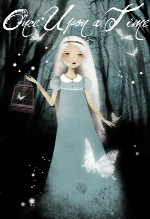 Peter and Max by Bill Willingham with illustrations by Steve Leialoha
From the jacket: “When an unspeakable tragedy befalls a family of traveling minstrels, they become stranded and left for dead. Here in the heart of The Black Forest, Peter Piper and his older brother Max encounter ominous forces that will change them both irreparably. Thus begins an epic tale of sibling rivalry, magic, music and revenge that spans medieval times to the present day when their deadly conflict surfaces in the placid calm of modern-day Fabletown.”
My take: Peter Piper and his wheelchair-bound wife, Bo Peep, live on a farm in upstate New York. Actually, they live on the outskirts of The Farm, which is an annex of Fabletown, the modern New York City neighborhood that is home to all manner of refugees from other, parallel worlds that inspire our fairy tales.
Peter (it was just one pickled pepper, not a whole peck, by the way) and Bo (she does love her sheep) get along pretty well in the modern world until one day Peter is informed that his brother, Max, has been sighted. Gathering intel from the Wolf (still huge and now married to Snow White) and the Witch (who has renounced her more wicked ways and these days is mostly just enigmatic), Peter sets out to track down Max — and to kill him.
Of course, there’s more to the story. Max is also looking to kill Peter. And he means business. Remember the Pied Piper of Hamelin? Cleared the town of rats and then took their kids, too? That was Max. He’s a charming fellow.
In case brotherly intrigue is not enough for you, there’s also a family heirloom in the form of a magic flute; a second, evil flute; a rebounded curse; and a curse on all of Fabletown. Max and Peter’s showdown might be secret, but everyone’s invested in its outcome.
The story, which alternates between Peter’s preparations to find his brother and flashbacks to his childhood and youth, is part of a larger Fabletown oeuvre by author Bill Willingham. I haven’t read the rest, most of which, I believe, are in the form of graphic novels, but this story has piqued my interest. I feel like this novel would be a good recommendation for reluctant teen readers, as it has the pacing of a comic, but in the fleshed out format of a novel. It would also be a good read for anyone who enjoys fairy tales or those who like alternate takes of classic stories.
Pages: 389
This was my fifth and final book for this spring’s Once upon a Time Challenge.
August 15, 2011
into the stacks: the harry potter series
posted by soe 1:13 am
For tonight, I’m skipping a review of Peter and Max in the interest of finishing a post and going to bed.
The Harry Potter series by J.K. Rowling
From the jacket: From my brain: Honestly, you know the summaries as well as I do. Harry Potter, the Boy Who Lived, does not die when his parents are killed by the most evil wizard in ages. Instead, the one-year-old is sent to live with his non-magical and abusive aunt and uncle and cousin, where he survives until his 11th birthday, when he finds out he’s a wizard and that he’s going away to a special school for other magical British kids. Once at Hogwarts, he makes friends, has trouble with schoolwork, and flies on a broomstick — typical stuff for the average pre-teen. We follow Harry through the years as he’s nearly killed by a possessed teacher, a memory, a house-elf (okay, that time he was only nearly grievously injured), another possessed teacher, several other evil witches and wizards, and the wizard who killed his parents and who’s now gunning for him. Ultimately there’s a showdown between the two, but not before Harry builds himself the family he lost as a child and finds himself to be the leader he never expected to become.
My take: It seems only appropriate to list all seven books together, as the tale would be incomplete without reading them all.
I pulled them out earlier this spring, when I needed a refresher before seeing the last movie. It’s interesting to see how much of what I remember is clouded by having seen the movies over the years.
I can say that the books are just as enjoyable after the most recent reading as they’ve been all the other times I’ve read them. And if you’ve somehow missed out on reading the series, you are in for a treat.
Pages: 4,083
August 11, 2011
booking through thursday: national book week
posted by soe 8:20 pm
Today’s Booking through Thursday assignment should be an easy one:
It’s National Book Week. The rules: Grab the closest book to you. Go to page 56. Copy the 5th sentence as your status.
Unfortunately, the closest book to me, Tea: A Global History, ends a chapter on page 56, and there is no 5th sentence on that page.
And while the book I’m currently reading, Diamond Ruby, also concludes a chapter on page 56, it has more than five sentences on the page. Here’s the appropriate one:
“As the front door slammed, Ruby sat very still for a few moments.”
For being located in a really emotionally draining scene, that’s a really dull sentence.