February 9, 2011
best reads of ’10
posted by soe 2:56 am
Six weeks into the new year, I thought I’d better release this into the wild before it becomes too late to do so. (That’s what happened last year — and the year before. I get behind on my reviews, think I should get caught up before I tell you what I like, and then spend too much time not getting things done.)
So this year I thought I’d do things a little differently. I’ll give you a paragraph about why I liked each book. If I reviewed the book, I’ll include a link to it. If I didn’t, well, then, I won’t.
I’d also like to note that the top five were really easy to narrow down. The rest were harder, which is why you’ll find a group of honorable mentions at the end. Because I’m not the Nobel Prize committee, after all, and I can do that if I want.
The best books I read in 2010:
(more…)
January 25, 2011
what’s in a name 4
posted by soe 1:48 am
I’m going to join another reading challenge. The eclectic ones tend to appeal to me most:
Between January 1 and December 31, 2011, read one book in each of the following categories:
1. A book with a number in the title
2. A book with jewelry or a gem in the title
3. A book with a size in the title
4. A book with travel or movement in the title
5. A book with evil in the title
6. A book with a life stage in the title
I’m currently reading The Magnificent 12: The Call, so I’ll be counting that toward the first challenge. I’m thinking Diamond Ruby for #2 and I am a Genius of Unspeakable Evil and I Want to Be Your Class President for #5.
I wonder if The Odyssey would count for #4…
Suggestions for titles you like that fit into these categories are always welcome.
January 23, 2011
into the stacks: the imperfectionists
posted by soe 3:39 am
 The Imperfectionists by Tom Rachman
From the jacket Powells: “Set against the gorgeous backdrop of Rome, Tom Rachman’s wry, vibrant debut follows the topsy-turvy private lives of the reporters, editors, and executives of an international English language newspaper as they struggle to keep it — and themselves — afloat. Fifty years and many changes have ensued since the paper was founded by an enigmatic millionaire, and now, amid the stained carpeting and dingy office furniture, the staff’s personal dramas seem far more important than the daily headlines.” [Dear publishers: I really hate it when you fill the backs of your book jackets with quotes instead of a synopsis of the book. If I hadn’t already been aware of this book, I absolutely never would have bought it.]
My take: I held off several days after reading this book to try to collect my thoughts, but five days out and I’m still at a loss. I started hearing buzz about this book last summer shortly after the hardcover came out. As so often happens, I filed it away to look for at the library and then promptly forgot about it until the holiday season, when I was tasked with buying presents for two old ladies who exchange gifts without actually really knowing one another or doing their own shopping. I contemplated it then, but ultimately went with a different book for each of them. However, when I saw that the author was coming to my local bookstore for a reading associated with the release of the paperback, I was intrigued.
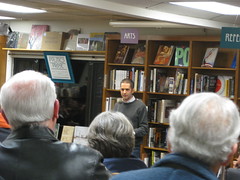 Tom Rachman seems unassuming and bashful and charming (although whether he is any of those things I leave up to people who’ve spent more than a minute with him) and the part of the book he read underscored my excitement at reading the book. I jumped right in.
The book itself, although described by many, including its publisher, as a novel is, in fact, a series of interconnected short stories, each focusing on a different person involved with a failing English-language newspaper based in Rome. Although each person interacts with the newsroom in some way (some are reporters, others editors, and a few outside the production of the daily paper), the focus of each vignette is on the character’s personal life and how that can affect their work life (and vice versa). Each character is individual and multi-layered and both likable and unlikable at the same time, and I suspect it is this that has garnered Rachman’s debut novel such praise. It’s a difficult skill for any writer to achieve at any point, let alone in their first published book.
And, yet…
I don’t think I liked it.
Have you ever watched The Office? It’s filled with characters you can sometimes sympathize with, but in general you don’t necessarily like, with the exception of Jim and Pam. This book was a lot like that, but without Pam or Jim to give you a clear protagonist to root for. You could make the argument that the newspaper itself should be what you’re cheering for, but by the end, I didn’t even really care if it survived, even if it was the major force in the lives of the dozen characters I’d just spent time with.
I admit to ambivalence about the book because I’m not sure I would have had the same reaction if I hadn’t read the final two chapters. I felt like these two stories veered off into darker places than I wanted to commit to, and the final piece, in particular, left me feeling like I’d been punched in the stomach. Without these final pieces, I can maybe see having liked the book overall, and just finding pieces of it a bit stressful, rather than leaving me with a distressing taste in my mouth that pollutes my whole opinion of the novel. [I had a similar reaction to The Elegance of the Hedgehog when I read it last year.]
I guess, in the end, I still don’t know what to tell you.
Pages: 283
January 18, 2011
this week in library books
posted by soe 2:21 am
The majority of the books I read are from the library, which is unsurprising, given how much I read. What I come home with tends to include a combination of random picks from the shelves and displays, books I’ve come in intending to track down, and books I’ve put on hold through the library’s web site (when you have 25 branches around the city, it can take a few days for end up someplace nearby).
This week, in addition to the afore-reviewed The Westing Game, I also brought home:
- Lev Grossman’s The Magicians, which I’ve been meaning to read for a couple of years (this is at least the second time I’ve checked it out from the library)
- Tarquin Hall’s The Case of the Missing Servant, which I heard about from Nan (I thought about buying it for Gramma for Christmas, but wasn’t totally convinced it would be her cup of tea without reading a bit of it)
- Leslie Connor’s Crunch, which I overheard recommended by a bookstore employee at Christmas and which recently made the shortlist for the Cybils (plus it has a bike on the cover)
- Michael Grant’s The Magnificent 12, which recently made the shortlist for the Cybils
- Cornelia Funke’s Reckless, which recently made the shortlist for the Cybils (and which I notice Grey Kitten just finished)
- Tara Kelly’s Harmonic Feedback, which recently made the shortlist for the Cybils
I have a few more books on hold at the branch by work that I have to pick up this week:
- The Sweetness at the Bottom of the Pie by Alan Bradley (I’ve been meaning to read this mystery since it came out; the third one in the series is either just out or due out any moment)
- The Manual of Detection by Jedediah Berry (another mystery that’s been on my list for a while…)
- The Woman in White by Wilkie Collins is the next book for the Classics readalong (I really hope it’s not too scary!)
What are you currently reading? Do you borrow much from your local library or do you tend to buy the majority of your books?
January 15, 2011
into the stacks: the westing game
posted by soe 3:24 pm
 This week’s Weekly Geeks, coming on the heels of major award announcements in children’s literature, encourages participants to choose one of four options relating to award-winning kiddie lit. Having just read the 1979 Newbery Medal winner last night, I thought the timing was perfect to avail myself of the third choice:
Review a new-to-you award-winning book this week
The Westing Game by Ellen Rankin
From the jacket: “This highly inventive mystery involves sixteen people (including a dressmaker, a secretary, an inventor, a doctor, a judge, a bookie,a burglar, and a bomber) who are invited to the reading of the very strange will of the very rich Samuel W. Westing. The could become millionaires, depending on how they play the game. All they have to do is find the answer — but the answer to what? The Westing game is tricky and dangerous, but the heirs play on — through blizzards, burglaries, and bombings.”
My take: Somehow I missed this children’s classic when I was growing up, but periodically since leaving college it has popped up on my radar screen and I always think, “I should track this down the next time I go to the library.” But by the time I next am choosing books to check out, it’s slipped back into the crevices of my mind.
This time, though, I was contemplating what to read for the Back to the Classics challenge and remembered to go looking for it at the library.
I’m so glad I did.
The general synopsis is this: Six families/individuals are approached about
moving into an empty, five-story, luxury apartment building on the banks of Lake Michigan. The rents are just what each of them can afford and they sign the leases immediately. Later in the fall, each of them (as well as the building’s three general employees) are called to the mansion of the building’s reclusive owner, Samuel W. Westing, paper magnate, to hear the reading of the will of the recently departed millionaire.
Instead of receiving a straight-up inheritance, they find they are paired off and tasked with solving who is responsible for Westing’s death. Each team is presented with a $10,000 check that both must sign to cash and four words to puzzle over.
Everyone returns to the apartment building to meet up with their partner and begin pursuing their task. As time goes on, they begin spending more time with one another, and, to their surprise, they find that their partner gives them just what they need, if not to help win the game, then to win at life.
I heartily recommend this to fans of mysteries, regardless of age, because it will keep you guessing until the end. Its madcap style also will appeal to fans of Clue (the boardgame, but I suppose also the movie), Monty Python, or It’s a Mad, Mad, Mad, Mad World.
I also want to note that the 2003 edition, which is what I borrowed from the library, contains the most heart-warming introduction I’ve ever read written by Ann Durell, Raskin’s editor and friend.
I’ll be checking out Raskin’s other books to see if they, too, are as sweet and as worth reading as The Westing Game ended up being.
Pages: 182
This novel also qualifies for a couple other challenges:
Just Read More Novels Month, for which this is my first contribution
and
Back to the Classics Challenge 2011, which I blogged about joining here. This qualifies as my children’s/young adult classic book.
January 13, 2011
win a free book: the metropolis case
posted by soe 12:21 am
I’m a GoodReads user and periodically enter to win free books. Last month, I learned I’d won an advance reader copy of Matthew Gallaway’s debut novel, The Metropolis Case, which was released Dec. 28. Crown Publishing sent me a review copy at the end of December. And then they sent me a second copy last week. Their confusion is your benefit because I’m hoping to share the redundant book with one of you.
Leave me a comment telling me either what your favorite book of 2010 was or what you’re most looking forward to reading in 2011 by Monday evening, Jan. 17, at 9 p.m. EST. I’ll randomly select one commenter and send The Metropolis Case off to you next week.
Crown’s summary of the book:
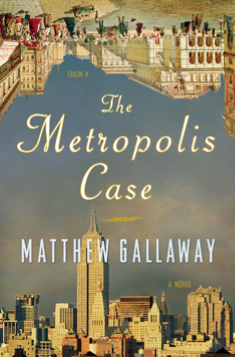 From the smoky music halls of 1860s Paris to the tumbling skyscrapers of twenty-first-century New York, a sweeping tale of passion, music, and the human heart’s yearning for connection
Martin is a forty-year-old lawyer who, despite his success, feels disoriented and disconnected from his life in post-9/11 Manhattan. But even as he comes to terms with the missteps of his past, he questions whether his life will feel more genuine going forward.
Decades earlier, in the New York of the 1960s, Anna is destined to be a grande dame of the international stage. As she steps into the spotlight, however, she realizes that the harsh glare of fame may be more than she bargained for.
Maria is a tall, awkward, ostracized teenager desperate to break free from the doldrums of 1970s Pittsburgh. When the operatic power of her extraordinary voice leads Maria to Juilliard, New York seems to hold possibilities that are both exhilarating and uncertain.
Lucien is a young Parisian at the birth of the modern era, racing through the streets of Europe in an exuberant bid to become a singer for the ages. When tragedy leads him to a magical discovery, Lucien embarks on a journey that will help him—and Martin, Maria, and Anna—learn that it’s not how many breaths you take, it’s what you do with those you’re given.
This unlikely quartet is bound together across centuries and continents by the strange and spectacular history of Richard Wagner’s masterpiece opera Tristan and Isolde. Grandly operatic in scale, their story is one of music and magic, love and death, betrayal and fate. Matthew Gallaway’s riveting debut will have readers spellbound from the opening page to its breathtaking conclusion.

