final unraveling of june
posted by soe 1:38 am
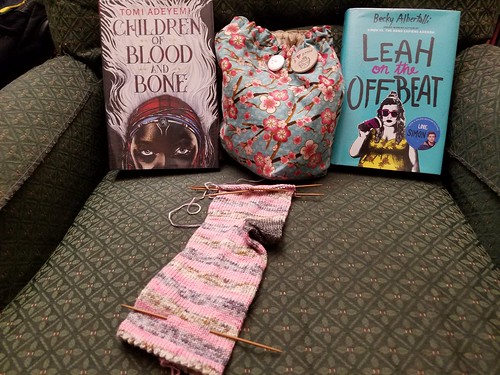
How can June nearly be over? Well, it is, so I guess I’d better get ready for July. The weather seems like it intends to welcome the change over with heat, although my weekend forecast now just shows upcoming temperatures in the upper 90s, rather than with a bleeding thermometer, like the long-term forecast had originally shown.
Nothing says heat of summer like some wool knitting, right? At least socks are small. I once spent an entire summer knitting a blanket with strips of Icelandic wool draped over my lap, which was not ideal.
My Posey socks are trucking along now. Amazing that sometimes all it takes is finding a way around the small problems holding you up (not being able to get the heel striping to work with the four-color sequence) to let you move ahead more quickly. (Or quicker, at least.) I am hopeful that I can get the pair finished before the Tour de France starts next weekend, when I want to start a shawl with some brightly hued gradient yarn my folks gave me last year. Photos and pattern mulling to come next week.
On the reading front, I’m still listening to Jenny Colgan’s The Bookshop on the Corner, in which only good things happen to the heroine, except for when they’re bad things that turn out to have been good things in disguise. There’s a lot of serendipity in the book and the heroine is instantly liked by everyone she meets and is good at everything she tries, seemingly without effort. Despite my seeming grumpy about the book, I am enjoying it (and the reader is excellent with all the accents!), but will require some “vegetable” books after finishing this very sweet one. I have several YA Sync downloads to listen to (maybe The Red Umbrella about the Peter Pan project that sent unaccompanied Cuban children to America in the 1960s) while I wait for books I’ve started to come back off hold. I’m #2 for American Street and it seems like a good time to dive back into a story about a young woman whose mother ended up in a detention center when they landed in the U.S.
On paper, I started Leah on the Offbeat by Becky Albertalli, her companion to Simon vs. the Homo Sapiens Agenda, this week and am about halfway through. A friend had been lukewarm about it, which probably helped to temper my expectations, so I keep being pleased with how much I like the story.
I’m a couple chapters into both Children of Blood and Bone and Octavia Butler’s Parable of the Sower, and it’s too early to tell how I feel about them.
Rudi is away this weekend and the Fourth of July gives me a day off next week, so I’ll have plenty of reading time in between protest marches and festivals. (And if the thermometer starts bleeding, I’ll take my book to the pool.)
Head over to Kat’s to see what other folks are reading and knitting.
midsummer unraveling
posted by soe 1:55 am
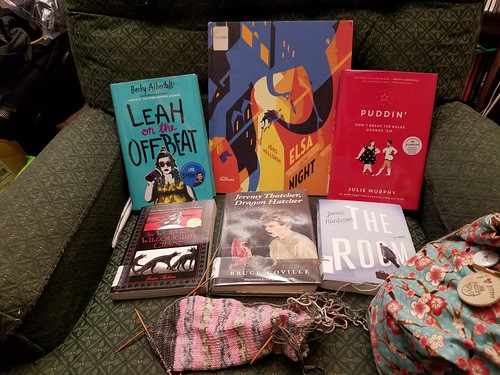
I finished up Hello, Universe this evening, so I thought I’d show you my Posey socks with tonight’s library haul (which also included three dvds — the Studio Ghibli anime version of Tales from Earthsea, the Israeli film that inspired the Broadway musical The Band’s Visit, and Film Stars Don’t Die in Liverpool).
Elsa and the Night and The Room are both Scandinavian books in translation. Jeremiah Thatcher, Dragon Hatcher and The Wolves of Willoughby Chase are both off the 100 best children’s books list that I was making my way through a few years back. And Puddin’ and Leah on the Offbeat are both new YA books by authors I really like. I also have Children of Blood and Bone out, which I’m eager to start.
mid-june unraveling
posted by soe 1:28 am
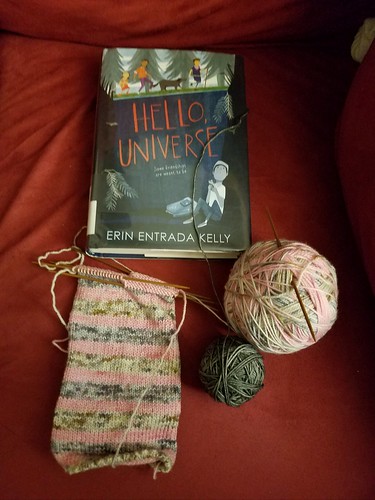
I’m nearly done with my azalea stripey socks and needed something to tide me over to the start of the Tour de France knit along, so I decided to pull out the Posey socks and get back to work on them. The grey skein will be the heels.
I’m two-thirds of the way through listening to A Conspiracy in Belgravia, the second of the gender-flipped Lady Sherlock novels by Sherry Thomas, and enjoying it quite a bit. The reader fits well, so I’d heartily endorse listening to it. In fact, I might go back and listen to the first one, I’m enjoying this one so much.
Hello, Universe by Erin Entrada Kelly won the Newbery Medal this year. It’s about four sixth-graders at the start of summer break, and 80 pages in, that’s still all I can tell you. It’s easy reading and not unenjoyable, but it’s taking a meandering route to the story and I’m feeling impatient to be into it already. I have a pile of books out from the library, so there are options for what will come next, but Children of Blood and Bone is a likely contender.
Head over to As Kat Knits if you’re looking for more of what folks are reading and crafting.
into the stacks 2018: february
posted by soe 1:15 am
Here are the four books I read back in February:
Eleanor Oliphant Is Completely Fine, by Gail Honeyman
Eleanor works in an office where she does her job diligently, if unimaginatively, says the wrong things (which are exactly what she’s thinking), doesn’t go out at night or on the weekend, and doesn’t have friends. Until one night when she wins tickets to a concert at the office and, fearing someone will ask her how it was, she goes and sees the man of her dreams. She understands, then, that it was destiny that brought her there and that she must apply herself to meeting the man (the singer of the local warm-up band) and to explaining they are meant for one another. (Her mother has long declared that Eleanor must wait until she finds a man of refinement worthy of their attention, and she’s eager to connive her way into this relationship through their weekly torturous phone calls.) This unlikely event kicks off a journey of self-improvement and self-discovery for Eleanor, opening her up to the possibilities that come from awkward interactions with the kindly new IT guy, Raymond, whom she’s walking next to on the way to the bus when they see a man pass out in the street.
The story, told partially through email, texts, and other ephemera, is set at a deliberate pace, but is ultimately full of heart. The first part of the book irritated me with its slowness, but I came to appreciate it as time went on and as I gained more insight into Eleanor’s character. After all, plot and character growth in our own lives is also uneven, with setbacks countering progress and days of wheel-spinning interspersed among steps toward full self-realization. Highly recommended.
Pages: 327. Library copy.
Wonder Woman: Warbringer, by Leigh Bardugo
In this young adult take on the story of how Diana, princess of the Amazons, becomes Wonder Woman, hero of the Western world, Diana sees a boat explode off the coast of Themyscira and sees a young woman struggling to survive. She rescues her to find she is a teenager, like herself, but she is far from home (New York) and there is a penalty among Diana’s people for bringing humans into her world. Before Diana can decide how to proceed, her fellow Amazons start falling ill and Diana learns from the island’s Muse that the girl, Alia Keralis, is responsible, being a descendent of Helen of Troy and, thus, destined to bring war, turmoil, and death in her wake. The Muse suggests that Diana should let the girl die to right the situation among the Amazons, but Diana decides there must be another way. There is, but it won’t be easy and it will involve a surprise trip to New York City and some new friends along the way.
I thought this was a well-told, multi-layered story with developed characters and a fast plot, particularly in the latter half. When I got to the end, I was glad I owned it because I felt I’d missed a lot of the background, particularly with regards to Greek mythology and that a re-read would earn me additional information. This is the first of the D.C. Icons series, each of which is written by a different author and which reveal the teen versions of D.C. Comics’ most beloved superheroes.
Pages: 364. Personal copy.
Magpie Murders, by Anthony Horowitz
Editor Susan Ryeland has her weekend planned: she’s got her favorite reading snacks and drinks, a weekend away from her boyfriend, and the latest manuscript of her most famous author, mystery novelist Alan Conway. But this is no relating of a delightful weekend, because Susan warns us at the outset that reading this manuscript brought her nothing but woe and changed her life forever. And with that, we are deposited into the story, what is meant to be the final book in the series about a detective, Atticus Pünd, who bears a close resemblance to Hercules Poirot. In that story, the aging detective is brought to a small English village to solve the death of a young woman’s soon-to-be mother-in-law. Characters are introduced, the plot is twisted, other deaths occur. And, because we all understand how English mysteries work, we wait for the famous detective to explain to the otherwise competent police inspector the who’s and why’s. Except … that doesn’t happen.
It turns out that the final few chapters of the manuscript are missing. Susan goes into the office on Monday expecting to find there’s been a copying mix-up, but soon learns that’s not the case. Oh, and to make it worse, Alan Conway has killed himself over the weekend.
Susan is nothing if not meticulous, though, and will act as her own sort of detective to track down the end of her writer’s final work. The pages must be somewhere, after all… But where?
I liked this book, which I listened to (and which had different readers for Conway’s novel and Susan’s story), well enough, but it was clear that Horowitz thought himself cleverer than I did. The book kept referencing the tv show Midsomer Murder, which Horowitz wrote scripts for, which seemed particularly gauche. I’d guessed the ending of Susan’s story, but not the reasoning and found the book’s motives were less compelling than the ones I’d expected. (Lest you think I’m tooting my own horn, my mother and I compared notes and we’d both expected the same plot. Plot twists are certainly in keeping with mysteries, but you’re supposed to feel that the author has given superlative hints all along that after the twist is revealed make you think how clever they are to have done so, not to think, “Really?! That’s what you’re going with?!”
That said, the story was certainly compelling and lots of people really liked it. I just would have liked my version better.
Pages: 502. Library (audiobook via Overdrive).
The Hen Who Dreamed She Could Fly, by Sun-mi Hwang (Translated by Chi-Young Kim)
After seeing a chicken in the yard with chicks, Sprout the laying hen loses interest in her primary function — and in life in general. If she cannot raise a chick from one of her eggs, what point is there to going on? She tries to escape (assuming freedom from her coop is all that’s missing from her path to motherhood), is rescued from a weasel by a lame mallard duck and her own will to live, and ultimately takes on the role of foster mother to a duck whose own mother was killed by the weasel. The book raises questions of individuality vs. group expectations, personal freedom, motherhood, sacrifice, and, ultimately, following your dream.
I’ve seen this South Korean fable (which I picked up to read during the Winter Olympics in PyeongChang) compared to Charlotte’s Web in a variety of places, and the D.C. Library has catalogued it as a children’s book. However, I’d argue the better comparison is to Animal Farm, since both are short novellas with adult themes. A child could read The Hen Who Dreamed She Could Fly, but then I read Animal Farm when I was in elementary school. I understood the basic themes, but probably missed some of the nuance and I assume the same would be true here.
Apparently there’s an anime version of the book. I found the book rather grim, but some people like that, preferring their reading to follow the contours of real life. I’m just not one of them.
Pages: 134. Library.
Total Pages: 1327