February 28, 2019
final february unraveling
posted by soe 1:12 am
I’ve started a new audiobook and am loving it:
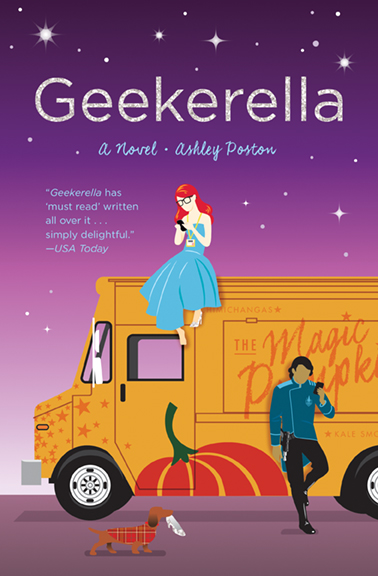
Geekerella, by Ashley Poston, is absolutely adorable. It’s about Elle, who lives with her stepmother and two stepsisters. She works in a vegan food truck, The Magic Pumpkin, and runs a fan blog for an old sci-fi tv series that’s about to be rebooted. Teen soap star Darien has been cast as the lead, Prince Carmindor, a character he adored and identified with as a kid, but his agent (who also happens to be his father), demands that he whiff the expert trivia question on morning tv for marketing purposes. They’ve started an anonymous texting conversation and while the characters are rather one-dimensional, I’m still enjoying it.
On the print front, I’m still working on Early Riser. So far, it’s predicated on a sense of dread, which does not make me want to speed through it, but there’s a love interest somewhere in the pages ahead, so I’m hopeful that it will pull me in yet.
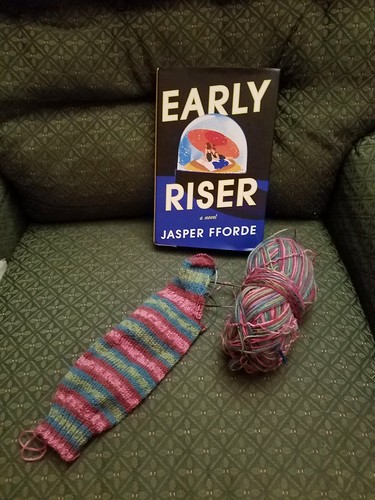
My sock got wonky, so I’ve ripped it back to the picking up stitches point. I can see what I did wrong and hope to be able to fix that, now that I’m paying attention. (I was knitting it during Jasper Fforde’s author event, so my focus was divided.)
I finished the sixth strip of my lightning shawl and have determined I don’t have enough yarn to knit a seventh strip. I have a call out on Ravelry for the 10 grams I’d need to finish, but I’ll block it in the meantime to see if I feel like it will work without it if need be.
Sock Madness begins this weekend, so stay tuned for a new work-in-progress next week!
Head over to As Kat Knits to see what other folks are crafting and reading.
February 21, 2019
mid-february unraveling
posted by soe 1:13 am
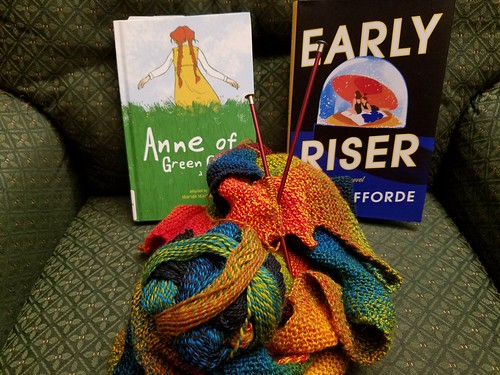
I think it was very nice of Jasper Fforde to publish a book to match my shawl-in-progress. I suspect I will be done with the book first, because I am nearly certain I have enough yarn to eke out a seventh strip so am going to go for it.
I am also reading this graphic novel adaptation of Anne of Green Gables, done by Mariah Marsden and Brenna Thummler. The illustrations are amusing and they manage to include most of the phrases we all love, but it’s missing the flavor of the original text. But it also moves really quickly. I only started it last night, but am already to the scene where they jump on Aunt Josephine.
I’m down to the last 45 minutes of The Woman Who Smashed Codes. World War II is over and William and Elizebeth are trying to figure out how to proceed with their lives during peacetime. He doesn’t die until 1969, so they’ve got some time to enjoy each other’s company. I hope they’re able to do that…
Head to As Kat Knits to see what else folks are reading and crafting.
February 20, 2019
top ten tuesday: unloved books you should read
posted by soe 1:08 am
Today’s Top Ten Tuesday topic at That Artsy Reader Girl asks us to promote books we’ve loved that need more readers. Specifically, we’re asked about books that have fewer than 2,000 readers on our review site of choice. According to Goodreads, I’ve read nearly 200 books that fall into that category.
Here are ten of them that I’ve enjoyed quite a bit (with the current number of ratings noted):
- Crazy ’08: How a Cast of Cranks, Rogues, Boneheads, and Magnates Created the Greatest Year in Baseball History by Cait Murphy (1,852 rankings): This history looked at the 1908 baseball season and ranked third on my list of favorite books way back in 2007.
- The Birds’ Christmas Carol by Kate Douglas Wiggin (1,145): This is one of those sentimental reads of mine. By the author of Rebecca of Sunnybrook Farm, this Victorian picture book focuses on the too-good-to-live Carol Bird who wants pleads with her family that her Christmas wish is to share her Dec. 25th birthday with the brood of poor children who live next door. It’s overly sentimental, bordering on mawkish, predictable for its time, and guaranteed to make you bawl. Sometimes you need that in a holiday read, though.
- Come Hell or Highball by Maia Chance (1,223): Where are my mystery lovers at?! This series is set in Prohibition Era New York and centers around the recently widowed Lola Woodby who discovers the day they bury her philandering husband that he was in debt up to his eyeballs and that their estate has been entailed to his health doctor younger brother. Desperate to avoid having to move home with her parents, she escapes to her late husband’s paramour nest in the City with her Swedish cook, Berta, where, inspired by their shared love of a particular potboiler series, they decide to become detectives for highbrow society. This is the first novel in the Discreet Retrieval Agency series, and you should really read it.
- The Harlem Charade by Natasha Anastasia Tarpley (624): You all know I love a good heist novel. Here’s one set in a middle-grade novel that will also give you some information on the Harlem Renaissance and the Studio Museum in Harlem. Its protagonists are two classmates working on a class project, one the Korean granddaughter of bodega owners and the other the white daughter of a wealthy developer who gives away food and metro cards to the needy, and the grandson of a Black man attacked in their neighborhood, who is now living on the street to avoid getting picked up by DCFS. As they seek to discover the cause of the attack on Elvin’s grandfather, the trail leads them to a decades-old art mystery and the way to save their neighborhood from being bulldozed.
- The Last Fifth Grade of Emerson Elementary by Laura Shovan (1,178): On the first day of 5th grade, a teacher informs her students they’re going to write a poem every day in class. This Cybils-winning verse novel shares a selection from each of the 18 students over the course of a tumultuous year of change and activism. Magnificently, Shovan succeeds in giving each kid enough of a distinct voice that you get so you can recognize a poem’s author without checking first.
- If God Invented Baseball by E. Ethelbert Miller (14): I wasn’t going to include 2018 publications in this list, because it seems like it’s not unreasonable that they haven’t gotten the readership of other books yet. But with only 14 rankings of this stellar collection from a renowned D.C. journalist and poet, I had to make an exception. He writes about baseball as a metaphor and baseball as baseball from the early glory days to the contemporary game and exalts in all the things that make baseball great — that it is completely and utterly human — something I wish the commissioner’s office and tv execs would keep in mind.
- Girl Detective by R.A. Spratt (903): I can only assume this middle-grade girl detective series hasn’t caught on because it’s Australian and thus hasn’t gotten the marketing for books written in the U.S. or Canada. Its protagonist, Friday Barnes, is a Sherlockian thinker who uses reward money from solving a bank heist to send herself to a boarding school, where she sets to unraveling mysteries for her classmates.
- A Properly Unhaunted Place by William Alexander (231): Rosa Ramona DÃÂaz and her ghost-appeasing mother have just moved to the library’s basement apartment in the only town in America where no spirits live. Rosa, irritated by her mother’s choice and missing her father, makes friends with Jasper Chevalier, whose parents run the local Ren Faire. When ghosts seem to descend upon the fair, she is able to fight them off, but there’s trouble afoot, and she is the only one who knows enough to be able to stop it. Apparently a sequel to this middle-grade ghost novel is in the works!
- Honest Engine by Kyle Dargan (41): When I read this collection of poems about loss back in 2016, I promoted it as “running the gamut from the State of the Union to sleep deprivation to a dozen or so poems about loved ones gone from this earth, with a surprising amount of science fiction fandom thrown in for good measure.” Apparently that’s a big sell, but I hope the verse lovers among you will seek out this volume from one of D.C.’s poets.
- Storybook Travels: From Eloise’s New York to Harry Potter’s London, Visits to 30 of the Best-Loved Landmarks in Children’s Literature by Colleen Dunn Bates and Susan La Tempa (48): Let’s be honest. One of the great things about reading is that you get to travel places near and far without cost or trouble. But sometimes, wouldn’t you like to experience the settings yourself? If children’s and middle grade novels are one of your true loves, this is the travel guide for you. It offered up ideas for books I’ve read and those I haven’t yet had the pleasure of yet, so consider glancing at it if you’re planning — or dreaming of — a vacation.
Honorable mentions go to Diamond Ruby by Joseph Wallace, The Collected Prose of Elizabeth Bishop, 101 Two-Letter Words by Stephin Merritt (with illustrations by Roz Chast), and James Thurber’s The White Deer.
What less-popular works do you recommend?
February 18, 2019
into the stacks 2019: february, part 1
posted by soe 1:51 am
I only finished one book in the first half of the month, so this will be short. (I’d expect a bunch for the end of February.)
The Emissary, by Y�ko Tawada (Translated by Margaret Mitsutani)
Set in Tokyo at some point in the middle-distance future, the rather loose story focuses on Yoshiro, a spry centenarian and former novelist, and the delicate great-grandson, Mumei, he is raising on his own. A great catastrophe — a radioactive one we are meant to understand — occurred a generation ago or so, causing Japan to close up its physical and metaphoric borders and create a dystopian, isolationist society in which foreign words — and concepts — are forbidden and the elderly do not seem to die (they now have three categories for senior citizens that include “young elderly,” which starts when you reach your 80s) or really even especially weaken (Yoshiro jogs daily, for instance, and his daughter works in an orchard picking oranges). Children, on the other hand, are so weak and constantly ill that they have difficulty eating, that doctors secret away their official medical reports and that parents are told to stop taking their children’s temperatures because they are always running fevers and it just depresses everyone. Mumei, despite all the suffering he seems to undergo simply by existing, is a rather philosophical child, with deep thoughts and a placid demeanor.
Most of the story is told from Yoshiro’s perspective, focusing on how life has changed and how much he worries about his great-grandson. A few chapters are told from his estranged wife’s perspective, when she comes for a rare visit from her school for children whose parents have moved elsewhere in Japan to work. A couple more are told from Mumei’s teacher’s point of view, as he considers language, the globe, and how the fragile children in his class interact with each other. And most of the final chapters in the book are from a teenaged Mumei’s perspective, as he navigates life from his wheelchair and prepares for an adventure. Each of these four characters will consider the importance of an emissary in one way or another.
You may remember that I partially picked up this slim novella because it had won the National Book Award for Translated Literature and also because its blurb suggested it was going to be a lot of fun. It’s possible I missed something, but I did not find the book “delightful, irrepressibly funny,” or “playfully joyous,” and it was really hard to separate the reality from that overbilling. I will say that the author and her translator clearly love and respect language greatly, as it’s a recurring theme in the work and that she has a reasonable concern for what the globe will look like in a few decades, regardless of whether there’s a nuclear meltdown, given the disaster-level scenario climate change is likely to wreak. So, a fair assessment of The Emissary is that it gives you a lot to think about, particularly given its length, but none of it is playful or fun.
Pages: 138. Library copy.
February 14, 2019
pre-birthday unraveling
posted by soe 1:57 am
Technically, it’s already my birthday, but no one else is up to know, so I’ve marked it with a midnight snack, some Netflix (the new She-Ra and the first Galentine’s Day episode from Parks & Recreation), and some knitting while listening to my audiobook of the moment, The Woman Who Smashed Codes, about Elizabeth Smith Friedman, who was the chief codebreaker in America in the U.S. leading up to and during World War II and who was then forgotten for more than half a century while her husband’s success (also as a renowned codebreaker) was lauded.
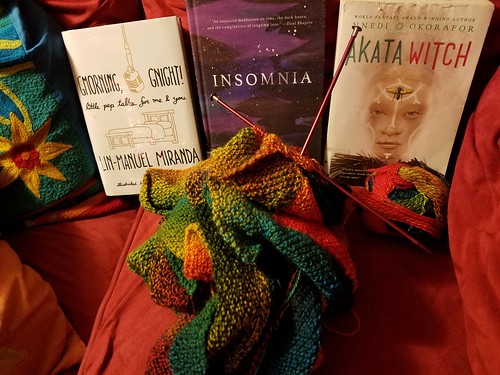
The shawl continues. It is optimistic, but not overly so, to think it could be done by next week, but six years of languishing on the needles certainly would not inspire anyone to place money on its completion. Certainly these three books will likely be done by then. Akata Witch is set in Nigeria and its young albino protagonist has recently discovered that she has magical powers. Insomnia is a series of musings about being awake overnight and touching on how while the condition is equated with a lack of sleep, it can also be full of creativity and thought and should perhaps be more celebrated than it is (but, also, she’s really tired). And Gmorning, Gnight! is a selection of Lin-Manuel Miranda’s pithy Twitter salutations illustrated by Johnny Sun. Much like short stories, I don’t have a lot of patience for either of these slender books when read at length, but enjoy them greatly when read for 10 pages or so at a time.
I have a bunch of other books I’d like to get to soon, including Angie Thomas’ sophomore novel, On the Come Up, and am looking forward to procuring Jasper Fforde’s new novel, Early Riser, at his booksigning on Monday. But in the meantime, these three books and my audiobook will do just fine.
Head over to As Kat Knits to see what other people are reading and crafting.
February 7, 2019
early february unraveling
posted by soe 1:41 am
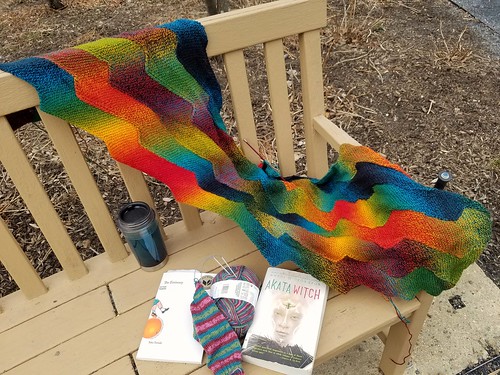
I took my books and knitting up to the park today to get an outdoor shot and some fresh air. My sock is into the heel flap, but I may end up hating how it disrupts the striping once I start the gusset, so I’m trying not to get too attached to the progress.
I’m also on a quest to resurrect some long-languishing UFOs, so out has come the Lightning Shawl. (Sorry, Mum. I know you hate seeing it not yet finished, a reasonable frustration given it’s now in its sixth year.) I will finish the second half of this sixth strip and assess whether I’m done or if I want to eke a seventh out from the leftovers. (This will definitely involve math and, if the yarn yardage works, may involve blocking what I have to see it needs it or not once it’s really done. I want it wide enough to be a shawl, rather than a scarf, and it definitely looks closer to the latter than the former.)
On the reading front, I am still listening to The Woman Who Smashed Codes and am reveling in the D.C. mentions. Tonight it was a restaurant with gendered dining rooms next to the Mayflower Hotel, which sits less than a mile from where I’m typing. The Emissary is overdue, which means I need to finish this novella tomorrow or Friday in order to return it to the library. I would still not use any of the whimsical adjectives attributed to it, so I’m hoping that feeling appears in the second half of the book. I started Akata Witch by Nnedi Okorafor last Friday. Its titular character is an American-born albino Nigerian who discovers she has magical powers and I am enjoying it so far.
Head over to As Kat Knits to see what other people are reading and knitting.